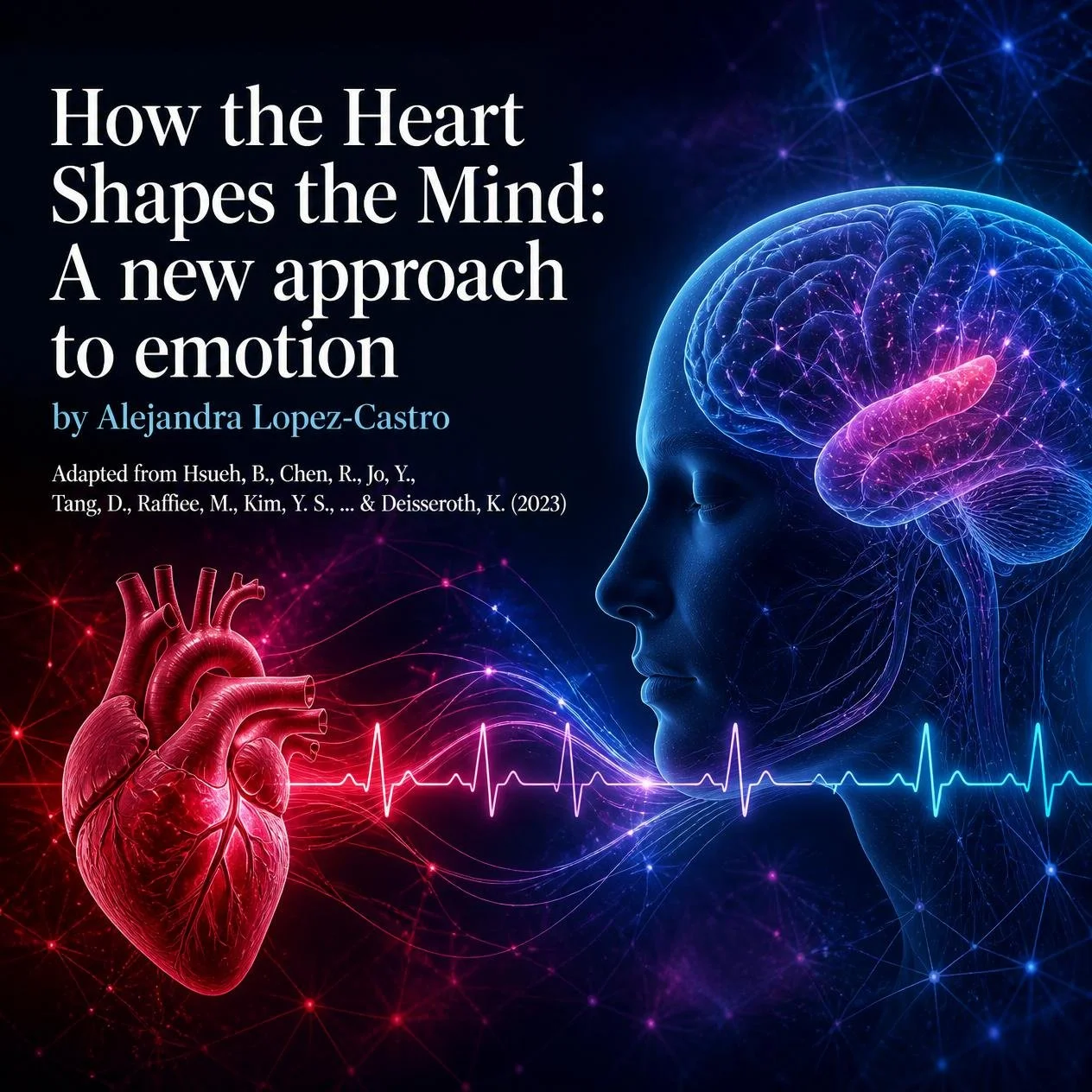
How the Heart Shapes the Mind: A new approach to emotion
Have you ever wondered whether your heart races because you're anxious, or if you're anxious because your heart is racing? In a landmark study published in Nature, Stanford University researchers—led by 2026 Nobel Laureate Karl Deisseroth—developed a noninvasive optogenetic pacemaker to artificially elevate heart rates in freely moving mice, proving that rapid cardiac rhythms directly drive anxiety and apprehension in risky contexts. By tracing this bottom-up physiological pathway to the posterior insular cortex (pIC) and demonstrating that optogenetically silencing this specific brain region completely erases the anxiety response even while the heart continues to beat rapidly, the team unveiled a fundamental mechanism of body-to-brain communication, offering elegant modern proof for William James's century-old theory of emotion.