Bringing it All Together: Neurosalience Live Audience Podcast at OHBM 2026
Written by: Peter Bandettini
Edited by: Elisa Guma, Yohan Yee, Ashley Tyrer, Simon Steinkamp
On the final day of the OHBM 2026 Conference in Bordeaux, Thursday June 18th, in the main ballroom “Agora” just a few hours before the closing ceremonies, Peter Bandettini will be hosting another annual live audience OHBM Neurosalience Podcast. The discussion will revolve around the fundamental challenge of curating, connecting, integrating, and deriving more readily understood meaning from the vast spread in neuroscience research. What tools and models can be developed to give us a broad and detailed vista of the latest neuroscience research? How might they point us to opportunities, gaps, or provide unanticipated insights? What cross-scale models might be built to unify disparate results across modalities and domains? How might these hypothetical tools and models foster collaborations and allow multiple groups and individuals worldwide to more effectively contribute to a growing compendium of readily available insight?
Those who have attended a Society for Neuroscience meeting, or even OHBM, have experienced informational vertigo. There’s just too much to take in and deeply challenging to get a solid bearing on the relevance of it all, and how it all fits together. The field of neuroscience, perhaps more than any other, is in need of tools that integrate results into a body of knowledge to enable a “ratcheting forward” of our understanding rather than a spinning of wheels within disconnected domains. To understand the brain, we need to bring together all domains and scales, but we also have to have a clear means to do this - accessible to all neuroscientists, from the graduate student to the lab director or department chair or even the funders or policy makers. We need to start speaking the same language to more readily comprehend how everything fits together.
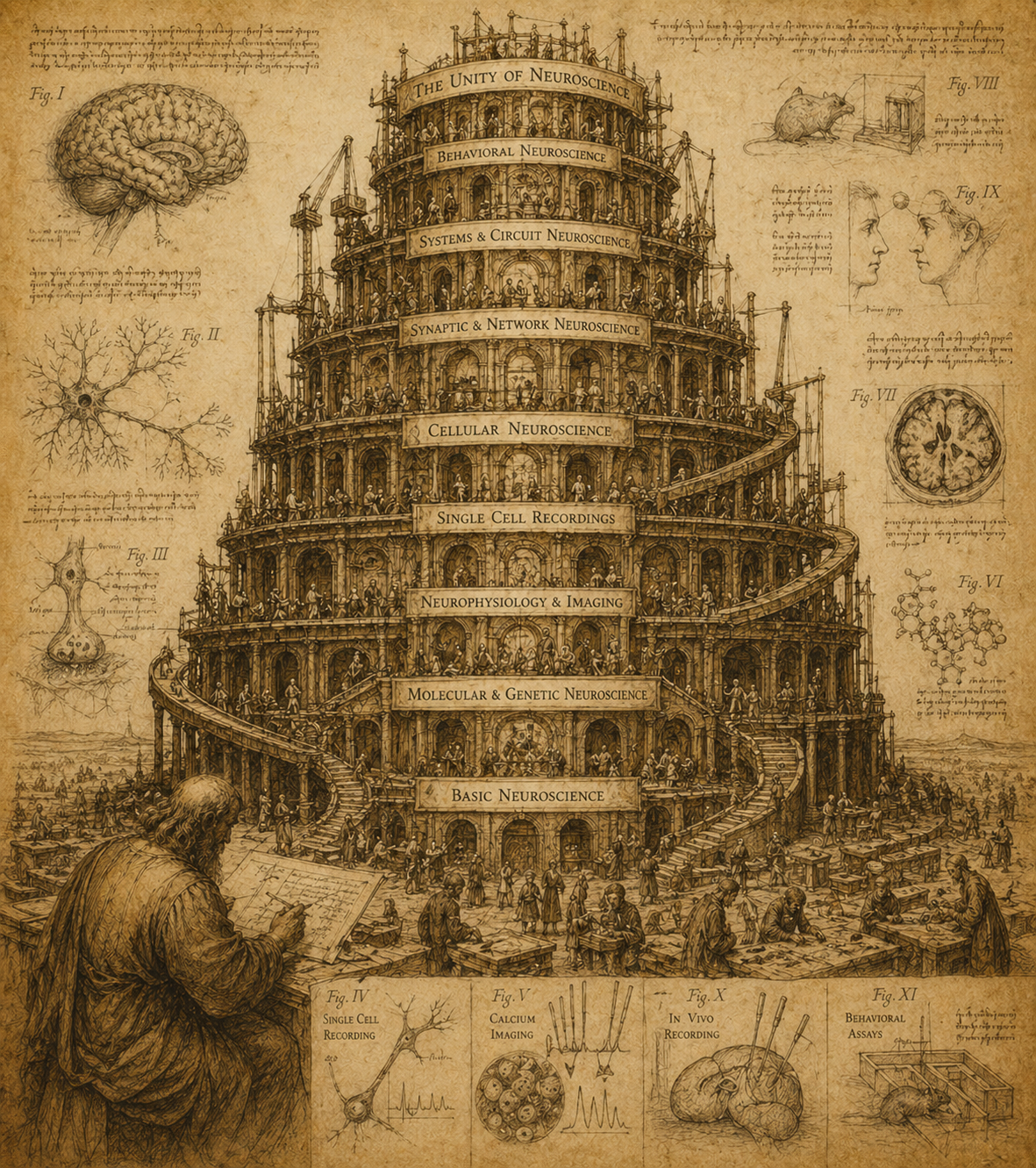
The current approach of presenting talks or posters at meetings, then publishing these results in journals, resulting in pdfs that others read and consider is far from optimal as we are all overwhelmed with backlogs of papers, models, and tools that any one individual or group cannot even begin to keep up with. The vision would be to create a unified, integrated compendium of new scientific information, each new finding integrated into the whole as it is characterized by biologic system, modality, scale, and a host of other metrics and then linked by an array of possible models that span from specific system mechanisms to global principles. This body of knowledge would be efficiently searchable, with the help of LLMs or more sophisticated approaches that consider nuances of mechanistic or other models of brain function across scale, and continuously nurtured with each latest development. In this manner, every individual doing research in neuroscience would readily grasp how their work and that of others from other domains and on other scales contributes to the whole. In addition, this would provide a tool perhaps by which researchers could discover new directions of inquiry that are most fruitful as the landscape of understanding is readily revealed. This would provide a living, growing database of understanding that is tightly integrated across domains, methods, and scales enabling more rapid progress and impactful, shared research by all of us.
Creating this new system would likely involve rethinking at a fundamental level, what the final output of our research would be. A simple pdf that people or LLMs consider is highly limited in this context. One can imagine that the output would include a measure of the replicability or soundness of the results and, in the case of models, a measure of how well they explain or predict the results currently contained in the growing compendium in addition to what, if any, predictions they may make. The construction for architecture of such a system would require a massive ongoing and organized collective effort not only to create it but to ensure its fidelity, scalability, and continued utility. The challenge is to balance a likely brittle and confining monolithic system with the currently loosely and variably connected bottom up, grass roots ad hoc organization.
In this podcast, we have a panel of four guests: Giulia Baracchini, a post doc from the University of Sydney, NSW, Australia; Vince Calhoun, the Founding Director of the Center for Translational Research in Neuroimaging and Data Science (TReNDS) at Emory University, Georgia State, and Georgia Institute of Technology; Satra Ghosh, Director of Open Data in Neuroscience Initiative and a Senior Research Scientist at the McGovern Institute for Brain Research at MIT; and Mario Senden, Assistant Professor Maastricht University, Maastricht, The Netherlands Department of Cognitive Neuroscience. They all have recently published insightful and important papers that approach the central challenge of the podcast in different yet complementary ways. The four papers are:
G. Baracchini, E. Muller, J. Shine, “Bridging the epistemological divide in neuroscience to improve ontological clarity” Aperture Neuro, 5: SI 1, 2025 https://doi.org/10.52294/001c.138841
V. Calhoun. “Data-guided neuroimaging and visualization: from functional decomposition to dynamic fusion.” Aperture Neuro, 5: SI 1, 2025 https://doi.org/10.52294/001c.140427
M. Senden, “The evolving landscape of neuroscience” Aperture Neuro, 6: SI 2, 2026 https://doi.org/10.52294/001c.156380
S. S. Ghosh, “An intelligent infrastructure as a foundation for modern science.” ArXiv https://doi.org/10.48550/arXiv.2508.10051
Dr. Baracchini’s paper states that we face epistemological divides as we all use different methods and tools that address different sets of questions, across different scales, on different systems. The field suffers from many silos, with researchers not communicating thus slowing advancement and leading to ontological clashes based on differences in understanding across sub-disciplines. We all have our domain-specific models of the brain, deeply tied to the spatial and temporal scale and the specific measurements that we make, and, resultingly, we are talking right past each other. Several solutions are suggested, including interdisciplinary training and exposure, objective benchmarks for our methods, and finally a unifying Map of Neuroscience. The Map of Neuroscience is more than just a map of all the components of the brain. It is a map that outlines how different subfields relate and intersect. This map would reveal a scaffolding of potential opportunities as well as a “concept space” across neuroscience and would likely reveal rich opportunities for future investigation. Ideally, it would grow to be an essential resource.
Dr. Calhoun’s paper tackles a growing crisis in neuroscience: the sheer impossibility of fully grasping the explosion of neuroimaging data, models, and analytic approaches without oversimplifying the brain itself. Rather than collapsing rich brain data into overly reduced summaries too early in the analysis process, he argues for staying closer to the data and preserving its high-dimensional spatial and temporal structure for as long as possible. The paper introduces a broader framework for thinking about functional decomposition methods, organizing them by where their information comes from (anatomic, functional, molecular, multimodal), whether they represent the brain in discrete or continuous ways, and how strongly they rely on predefined assumptions versus data-driven discovery. Across topics ranging from dynamic brain states to multimodal fusion and expressive visualization of AI models, the paper argues for a future in which neuroimaging methods are not only more powerful and predictive, but also better able to reveal the hidden structure, variability, and dynamics of the brain itself
Dr. Senden's paper offers a diagnosis of neuroscience's structural challenges. Using an AI-assisted pipeline to analyze over 460,000 articles published across 25 years, he constructs an empirical Map of Neuroscience, identifying 175 research clusters and characterizing how they relate across dimensions of scale, method, and theoretical engagement. The picture that emerges is of a field that exhibits a surprisingly high degree of knowledge exchange across its various research domains. At the same time, it remains fragmented across spatial and temporal scales and heavily relies on narrow mechanistic accounts while overarching theoretical frameworks that could unify findings across scales have not penetrated the field's research structure deeply enough to constitute organizing forces. These findings have since motivated ongoing pedagogical and conceptual work aimed at giving neuroscientists the conceptual tools to engage more deliberately with theoretical frameworks
Lastly, Dr. Ghosh’s highly ambitious and far-reaching paper argues that all of modern science, and specifically neuroscience, needs a new, AI-aligned, intelligent infrastructure that is self-learning, rather than our current fragmented patchwork of tools and repositories. He argues that the scientific infrastructure itself should be treated as an instrument for discovery that itself learns, coordinates, and improves, instead of a static scaffolding built by individual labs or time‑limited projects. He lays out eight challenges: Complexity, Data explosion, Fragmentation, Skill gaps, Infrastructure inequalities, ethical fragmentation, biased attribution, and underfunding. He argues for AI to be an active collaborator in science and finally, he spells out design principles for “intelligent architecture.”
Recently, also, The Transmitter put forth a set of articles and tools “The State of Neuroscience” with a similar goal - to map out the landscape of neuroscience to get a better perspective of how the field is organized and how it is evolving over time. Drs Senden and Ghosh have also teamed up to create a tool for performing multidimensional exploration of abstracts for OHBM. This will be incorporated into Aperture Neuro for exploring in increasingly large compendiums of papers from journals - allowing researchers to identify connections and perhaps opportunities as indicated in relationships or lack thereof between papers along chosen dimensions of comparison.
My sense is that an increased focus on dynamic modeling using across-scale networks or perhaps other types of constructs as a means to bridge data, scales, and methods of measurement will provide some of the most tractable ways forward. The models promise to explain mechanisms at scales smaller and faster than those observed, yet also predict measures at larger, slower timescales, thus fostering the generation of testable hypotheses or scale-straddling models for future research and collaboration.
I am very much looking forward to leading this discussion. A few questions for discussion immediately come to mind. What is working well in terms of advancing neuroscience and connecting the research across scales and modalities in a meaningful way? What is not working well? What in your view is the precise nature of the problem? Is it changeable or will it naturally just evolve over time? How will it be scalable? Where are the shortcomings? How, as a whole, is neuroscience and neuroimaging "inefficient" or not progressing as rapidly as it could? What are some short term solutions? What would be the long term solution? What can we realistically do to help organize and focus this process? How do we incentivize the community to participate? What do you see as necessary to happen at the social, funding, and infrastructure building level, in order to start creating a system that helps to move neuroscience research forward more rapidly and completely - not only for fully “understanding” the brain but for finding novel and powerful clinical applications?
Between now and then, I will be reading up and generating more questions that will likely lead to lively exchanges, hopefully provide some insights, and perhaps help the field move forward. Please attend and bring your own questions as we will be engaging the audience in the discussion as well!