OHBM Abstract Atlas
OHBM Abstract Atlas: a guide to content being presented at the 2026 Annual Meeting and the connections between them
Authors: Satrajit Ghosh, McGovern Institute for Brain Research, MIT
Mario Senden, Department of Cognitive Neuroscience, Maastricht University
Editors: Yohan Yee, Beth Slater
Ever wondered what an atlas of abstracts would look like? Well, just like brains, now you have 15 atlases to choose from, but to set your attention free you get started with a default mode!
Satrajit Ghosh and Mario Senden have mapped this year's accepted abstracts for the OHBM 2026 Annual Meeting into an OHBM Abstract Atlas, a starting point for a much greater connectivity into an atlas of neuroscience. The tool also contains abstracts of published articles in addition to OHBM 2026 abstracts, and you can view this year’s 3,240 conference abstracts positioned within the landscape of the larger neuroscience literature (“NeuroScape PubMed Atlas”, >461,000 articles from 1999-2023).
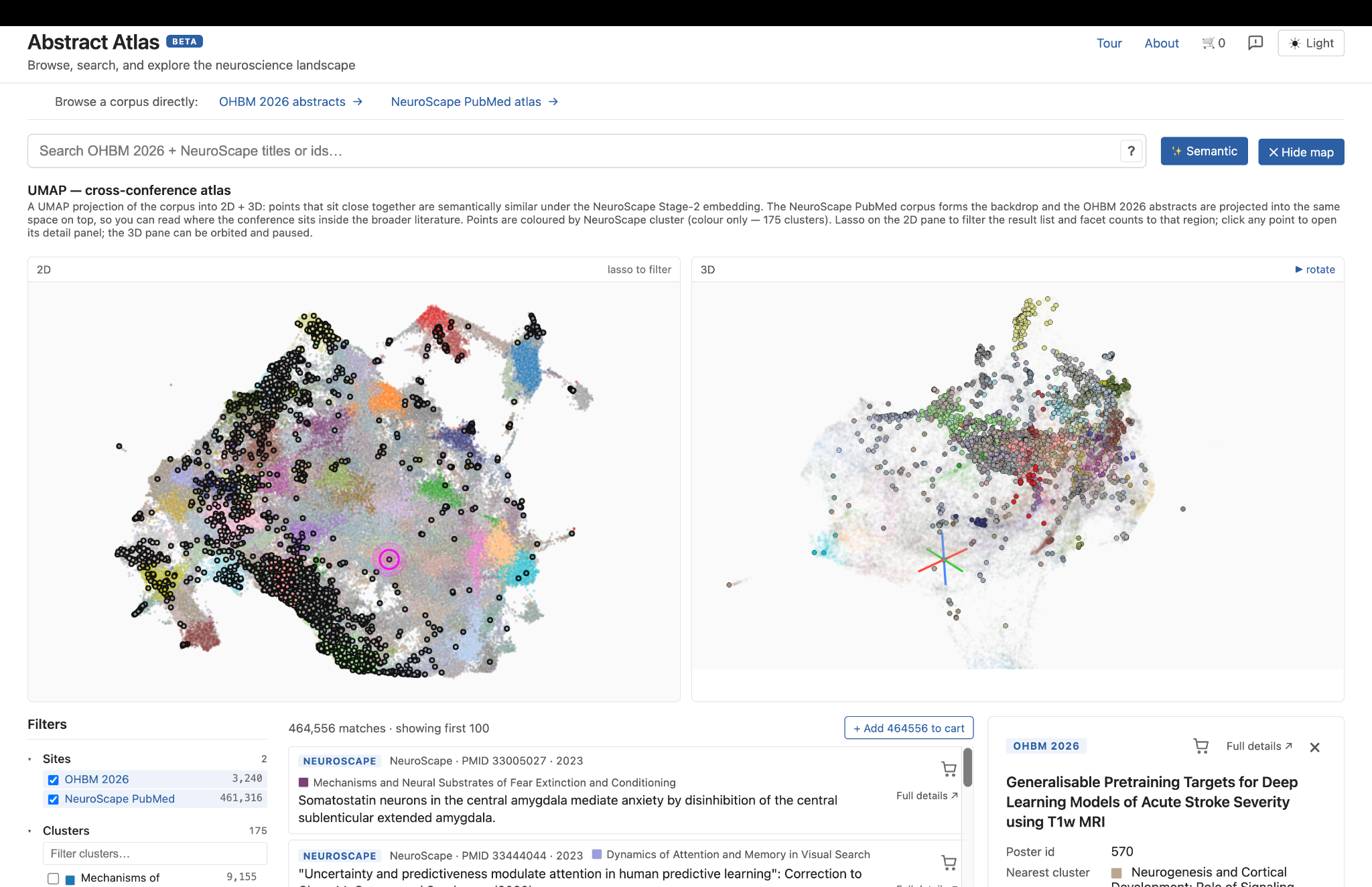
This interactive atlas can be explored in 2D and 3D, allowing you to navigate abstracts, discover connections, and find themes and clusters. You can search semantically (e.g. for language, disorders, or specific topics), or simply browse and collect items of interest into a cart of curiosities that you can email yourself.
For a more guided experience, the faceted search panel on the left will get you to nodes supplied by the authors themselves, that have many laminae and types. When you explore the depth of an abstract, you may see some evolving AI/ML (✨) generated content and some distances on some embedded manifolds. If you see spurious claims, please let the creators of this resource know through the chat icon on the top of the site.
Need even more structure? Take the 60-second guided tour of the atlas to explore key features and landmarks via the “tour” button at the top of the tool.
This is a truly exciting creation for the OHBM community; it will help you better navigate the extensive content presented at the annual meeting, and has great potential to spark new connections and insights. Perhaps most importantly, the ✨ + human generated code that generates this is all open, and the atlas content itself is accessible if you wish to explore further. Have fun exploring!