Maiken Nedergaard and the Discovery of the Glymphatic System
By Luis F. Rivera-Chavez
We usually do not think much about waste removal until it stops working. A city without sewers would quickly become unlivable. Just like a city has sewers, most tissues in the human body have lymphatic vessels that help clear fluid, proteins, and waste products. But for a long time, scientists faced a puzzle. The brain, one of the most active organs, did not appear to have these lymphatic vessels. It was assumed that the cerebrospinal fluid (CSF) that circulates around the brain and through cavities within the brain called ventricles served as a sink for brain extracellular solutes. However, the route from the actual brain tissue to CSF was unclear. The brain seemed to have a way to clear solutes. The question was, through which door?
How was the system discovered?
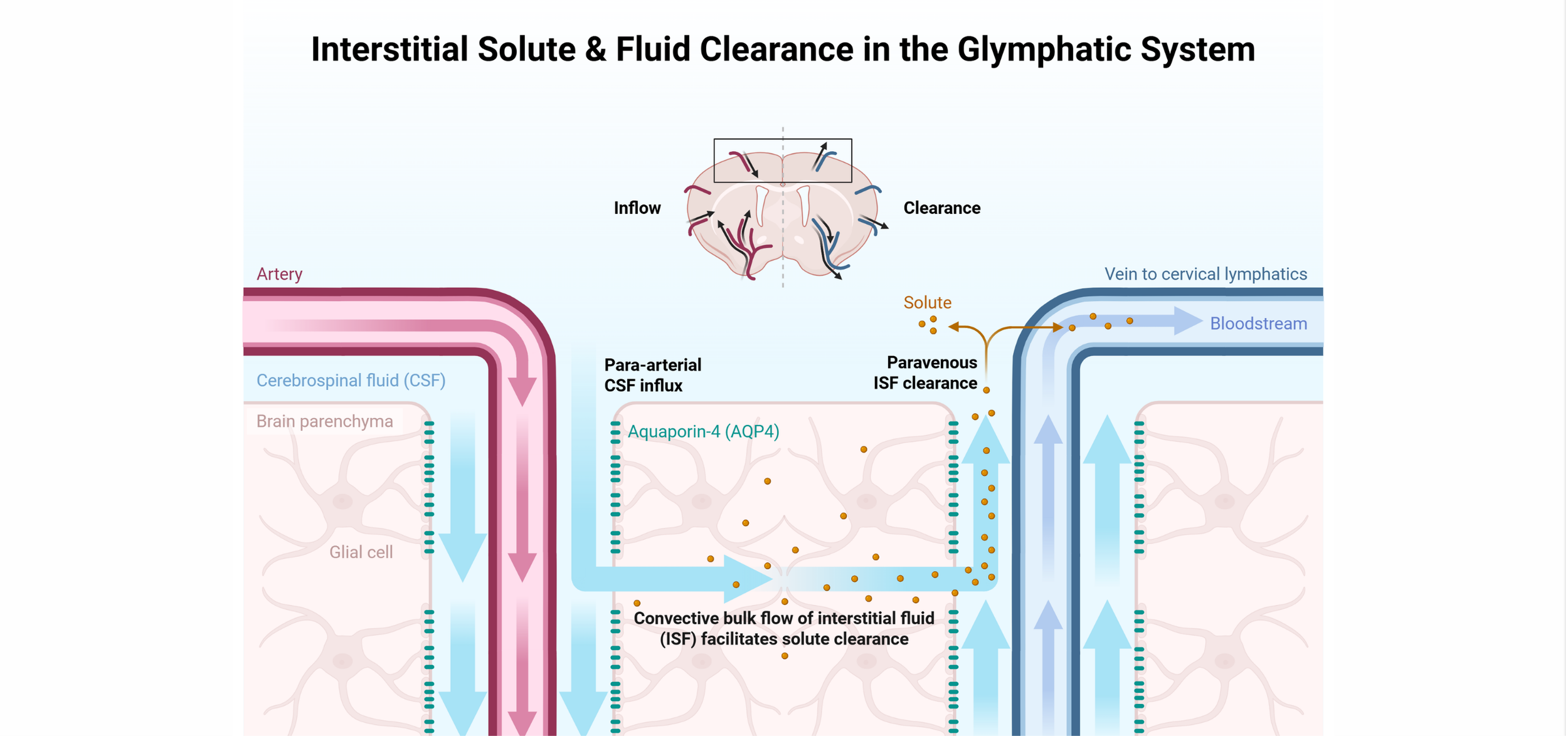
In 2012, the group led by Maiken Nedergaard, with Jeffrey Iliff as first author, reported a brain-wide pathway that helped explain how CSF moves through brain tissue and helps clear waste. This discovery was the result of numerous experiments in mice in which they were able to monitor the CSF flow pathways. By injecting tracers into the CSF of mice, the team was able to conclude that CSF in the space surrounding the brain, called the subarachnoid space, entered brain tissue relatively quickly. Then, using a method called in vivo two-photon imaging to visualize CSF movement in real time, they found that CSF was not entering brain tissue randomly. It actually followed a vessel-associated path, where CSF entered along para-arterial routes, while interstitial fluid and solutes cleared along paravenous routes.
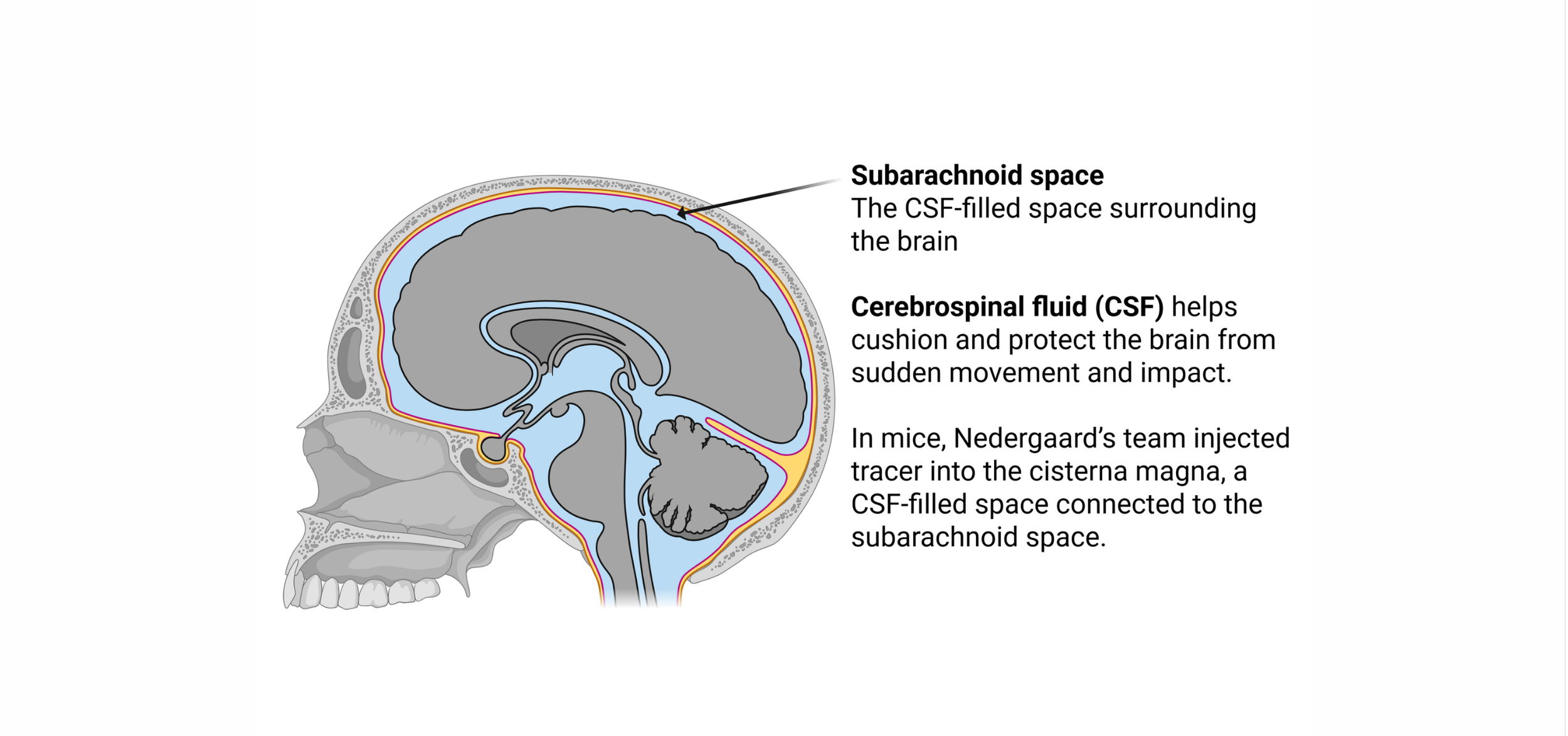
Image made with Biorender.
How does the glymphatic system work?
In simple terms, CSF enters in specialized channels surrounding arteries, exchanges with fluid between brain cells, and helps carry solutes out alongside veins. The team also identified a specific protein called aquaporin-4 (AQP4) that helped facilitate the movement of fluid from these vessel-associated spaces into the brain tissue. AQP4 is a water channel highly concentrated in the endfeet of astrocytes, a type of glial cell. That is how the name glymphatic system came to be. This newly discovered system depends on glial water flux and performs a lymphatic-like clearance function. The authors then tested whether this system was connected to one of the major ideas in Alzheimer’s disease research: the accumulation of amyloid β.
Why does this matter for Alzheimer’s disease?
Amyloid β is a protein strongly associated with Alzheimer’s disease and is a major focus of theories about how the disease develops. In mice, Nedergaard’s team found that soluble amyloid β could be cleared along this paravascular pathway and that AQP4 helped that clearance. This is particularly exciting because perhaps the brain’s health may depend not only on how much waste is produced, but also on how efficiently the brain can remove it. Before this work, an important part of brain waste clearance remained a biological mystery. After it, researchers had a new system to investigate, new mechanisms to test, and new ways to think about diseases where proteins accumulate in the brain.
Can we measure this system in the living brain?
After discovering the brain’s hidden cleaning pathway, Nedergaard and colleagues began asking whether scientists could actually observe this system work in the living brain. In a later study published in 2013, they showed that dynamic contrast-enhanced MRI could capture glymphatic CSF-interstitial fluid exchange across the rat brain in vivo. This provided a proof of concept that glymphatic function could be measured using a clinically relevant imaging approach. One exciting possibility is that this approach might eventually help researchers evaluate Alzheimer’s disease susceptibility and progression in humans.
Made with Biorender.
When does this system work best?
The discovery also helped connect the glymphatic system to other aspects of brain physiology, especially sleep. We’ve known for a while that sleep is a basic function of the brain, and Nedergaard’s work offered a possible biological link between sleep, brain waste clearance, and molecules associated with Alzheimer’s disease. In another study from Nedergaard’s team, they tested whether this clearing system was more active and helped clear amyloid β faster during sleep than during wakefulness in mice. In sleeping mice, the space between brain cells expanded, CSF flowed more easily through the brain, and amyloid β was cleared faster than during wakefulness. Further studies are still needed to fully understand this system and its clinical implications, but the door has been opened.
As it turns out, the brain was never a city without sewers. Its drainage system was simply hidden in plain sight, wrapped around blood vessels and supported by glial cells.
Sources:
