Rogier Mars and the Brain’s Animal Past
By Luis F. Rivera-Chavez
As a psychiatrist, I often explain anxiety to patients as an alarm system. It did not appear out of nowhere. Across our evolutionary history, nervous systems that were better at detecting danger helped organisms survive. Whether it was a rustle in the bushes, a threatening face, a painful memory, or today, even the possibility of being late, our brains became remarkably good at anticipating what might harm us.
Evolution does not design perfect machines, that’s for sure. It works with what is already there, modifying old systems for new problems. The same alarm system that can protect us can also become too sensitive, turning uncertainty into fear and possibility into threat. In that sense, anxiety is a powerful reminder of something broader. To understand the brain, we need to understand where it came from.
That is the spirit behind the work of neuroscientist Rogier B. Mars. His research compares human brains with those of other species, not to rank them from simple to advanced, but to ask a more interesting question: how did different brains evolve to solve different problems? His new book, The Fox, the Shrew, and You: How Brains Evolved, brings that question to a general audience, inviting us to see our own brain as an evolved organ shaped by ancestry, ecology, and chance.
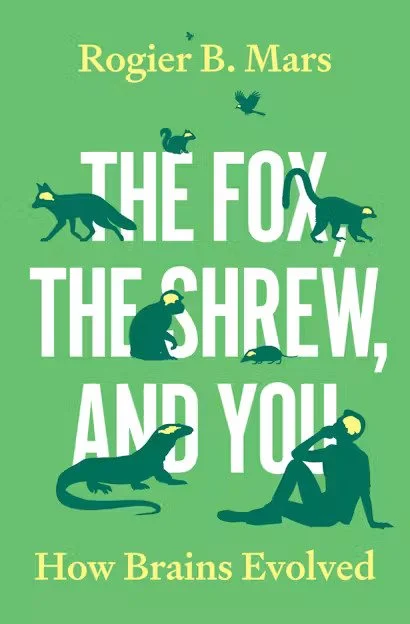
In the book, Mars takes readers through brain evolution using animals as guides. The journey begins with creatures that seem very far from us, including the sea squirt. As a larva, the sea squirt swims through the water looking for a place to settle. Once it finds one, most of its early nervous system disappears. In the popular version of the story, it “eats its own brain” because it no longer needs it to move around. Mars uses this strange example to make a larger point. Brains did not evolve simply for abstract thought. They evolved to help organisms act in the world.
One of the book’s central ideas is that brains can be understood, in part, as “foraging devices.” They help living beings find what they need to survive, especially when food is difficult to obtain, scattered across space, or available only at certain times. As environments changed, different species faced different problems, and their nervous systems were shaped by those pressures.
But foraging is not only about food. In many animals, survival also depends on others. One of my favorite examples in the book is the comparison between chimpanzees and bonobos. These two close relatives were likely separated by the Congo River. South of the river, bonobos had access to larger patches of high-quality food. North of it, chimpanzees faced more limited food and competition with gorillas. Mars explains how these different ecological pressures may have contributed to different social worlds. Bonobos became more tolerant and socially relaxed, while chimpanzees developed more competitive and aggressive social dynamics.
These examples make the book feel less like a textbook and more like a guided tour through evolution. A sea squirt, a shrew, a macaque, a dog, a chimpanzee, a bonobo, and a human are not placed on a ladder from simple to superior. They are presented as different answers to different survival problems. That is what makes the book so engaging. It helps us see the human brain as one biological possibility among many, shaped by the same evolutionary forces that shaped every other brain.
This idea is also central to Mars’s scientific work. In one of his publications, he and his colleagues discuss the relationship between the default mode network, or DMN, and the social brain. The DMN is often described as a network that becomes especially active when we are not focused on an external task. However, Mars and colleagues note that parts of this network overlap with regions involved in social cognition, including thinking about other people’s minds. Interestingly, networks resembling the DMN have also been described in macaques and chimpanzees, which raises fascinating questions about how social cognition evolved across primates.
Social behavior is not the only domain where humans share brain organization with evolutionary relatives. In another study, Franz-Xaver Neubert, Rogier Mars, and colleagues compared frontal brain regions involved in reward-guided learning and decision-making in humans and macaques. Instead of assuming that two brain areas are equivalent because they look similar, they compared their patterns of connectivity. They found that many human frontal decision-making regions have macaque counterparts, while some regions may not have a straightforward match.
These findings are especially interesting because the frontal cortex is often invoked when people talk about what makes human cognition special. But Mars’s work complicates that story. Some frontal circuits involved in learning, reward, and decision-making are shared with other primates, while other regions may have changed in ways that support abilities especially developed in humans.
Rogier Mars continues to study the human brain through quantitative comparisons across species. I’m glad he decided to write a book that brings this perspective to a wider audience. The Fox, the Shrew, and You leaves readers with a humbling idea: the human brain is extraordinary, but not because it stands outside evolution. It is extraordinary because it belongs to it.
If this evolutionary journey through the brain leaves you curious, a recent interview with Rogier Mars offers a great companion read, with more about his scientific work and the ideas behind The Fox, the Shrew, and You.
Sources:
