How Your Brain Makes Sense of the People You Know
By Veronica Diveica
Interacting with people you know often feels natural. You might sense that your friend is nervous before giving a presentation, or that your sibling is joking even when their words sound serious, and you might know just how to respond. But reading minds to guide our actions is anything but simple. We can’t directly see what others are thinking or feeling, so we make guesses about others’ inner states from subtle, sometimes ambiguous clues, such as a glance, a posture, or a choice of words. All in a split second.
The tricky part? People are different. The same situation can elicit very different reactions. Someone might feel excited to be the center of attention, while another might feel intimidated, and yet another might respond differently depending on whether the attention comes from friends or strangers. Your best response can also depend on the person. One friend might want a comforting hug when sad, while another might prefer a distraction. Smooth social interactions, therefore, benefit from knowing the idiosyncrasies of the person you’re interacting with. How do we keep track of what different people are like and use that knowledge in the moment?
Researchers Mark Thornton, Miriam Weaverdyck, and Diana Tamir proposed that the brain solves this by representing each person as the sum of the mental states they tend to experience. Mental states refer to people’s “inner” experiences that others cannot observe directly, including emotions, thoughts, intentions, beliefs, and desires. Unlike traditional views, which suggest we understand others through enduring personality traits, such as sociable or trustworthy, that change little over years or decades, their approach emphasizes the importance of temporary states, such as surprised or embarrassed, that can shift from one moment to the next. This emphasis on moment-to-moment states is what makes their proposal novel.
To test this idea, the researchers looked at brain scans for over 70 participants across three independent studies. Participants were asked to either think about different mental states or about famous people while their brain activity was recorded with an MRI scanner.
The researchers first identified the patterns of brain activity associated with thinking about specific mental states, like joy or sorrow, and about specific famous people, like Queen Elizabeth or Kim Kardashian. Then, they asked another set of participants how often they believed each famous person experiences each mental state.
The researchers reasoned that if the brain represents people as the sum of the mental states they tend to experience, then thinking about a specific famous person should activate a pattern of brain activity similar to a “blend” of the brain activity patterns associated with those mental states. In other words, the brain’s representation of a person should reflect a combination of the mental states they are likely to experience, based on what we know about them.
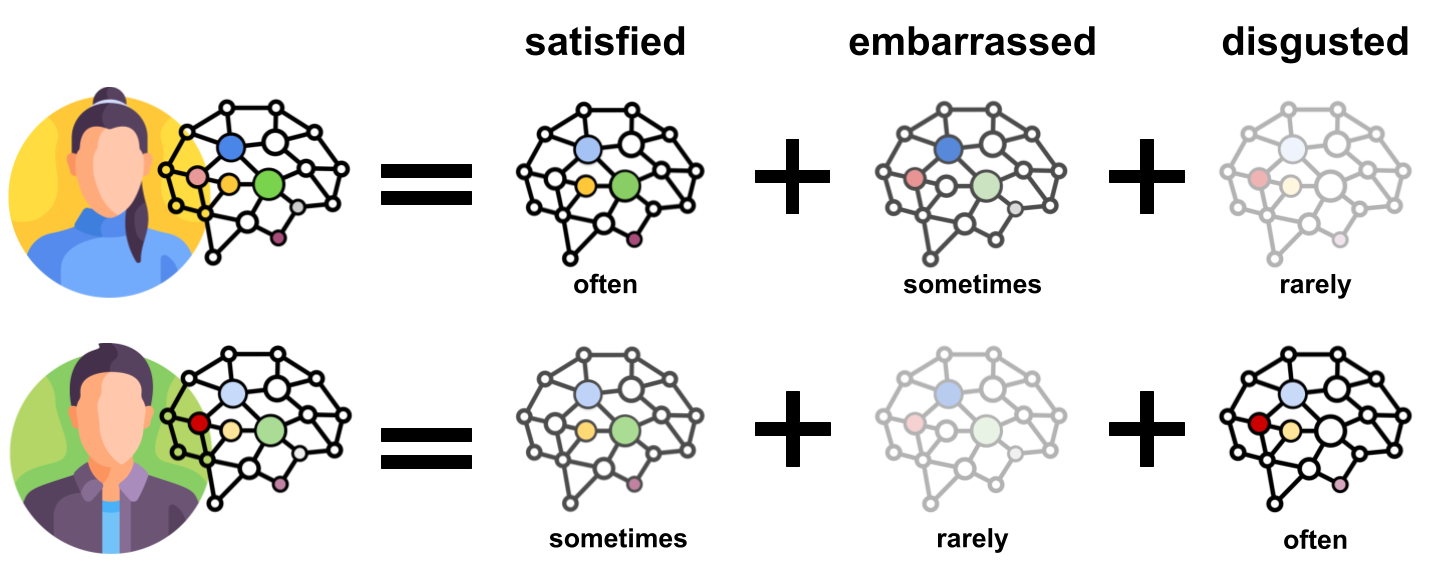
And that’s exactly what they found. Participants’ brain activity while thinking about a specific famous person could be reconstructed from the brain activity patterns associated with the mental states that person typically experiences. Moreover, the more similar famous people were in the mental states they tend to experience, the more similar participants’ brain activity patterns were when thinking about them. This similarity, based on mental-state knowledge, was stronger than similarity based on personality traits, suggesting that our brains rely more on temporary mental states than on enduring traits when thinking about others.
This study used well-known public figures rather than personally familiar individuals about whom participants would have richer knowledge. The use of public figures allowed the researchers to use the same stimuli for all the participants, ensuring experimental consistency. Nonetheless, the findings support the idea that knowledge about the mental states people tend to experience plays a key role in how the brain represents those we know personally.
Why focus on mental state knowledge? First, mental states can be inferred in real time from what people say and do. For example, people often laugh because they are amused and cry because they are sad. In contrast, inferring stable traits requires observation over a longer period of time. Second, mental states help predict how people will behave. For example, someone who feels anxious may avoid a situation, while someone who feels confident may take the lead. Current mental states also help predict what mental states people are likely to experience next. For example, someone who feels frustrated is more likely to become angry than joyful. As the authors put it, “attending to mental states allows perceivers to gain useful glimpses of the social future”.
Source: Thornton, M.A., Weaverdyck, M.E. & Tamir, D.I. The brain represents people as the mental states they habitually experience. Nat Commun 10, 2291 (2019). https://doi.org/10.1038/s41467-019-10309-7